
Why Your Table Feels Incomplete
I've run the same campaign for six years with the same $12 dice.
Every Thursday night, same table, same twelve people, same worn plastic bag of dice rolling across the felt.
I'd built everything else — custom tray, hand-painted screen, 3D-printed minis so detailed my players would stop mid-turn just to look at them.
But those dice sat there like I'd forgotten to finish the job.
I remember scrolling through old campaign photos one night and noticing it: in every single image, my whole table had evolved except that one plastic bag in the corner.
My players had no idea it bothered me.
I'd never said a word about it.
But it did.
It bugged me more than I want to admit — like I'd spent years building this whole identity as a DM and left the centerpiece unfinished.
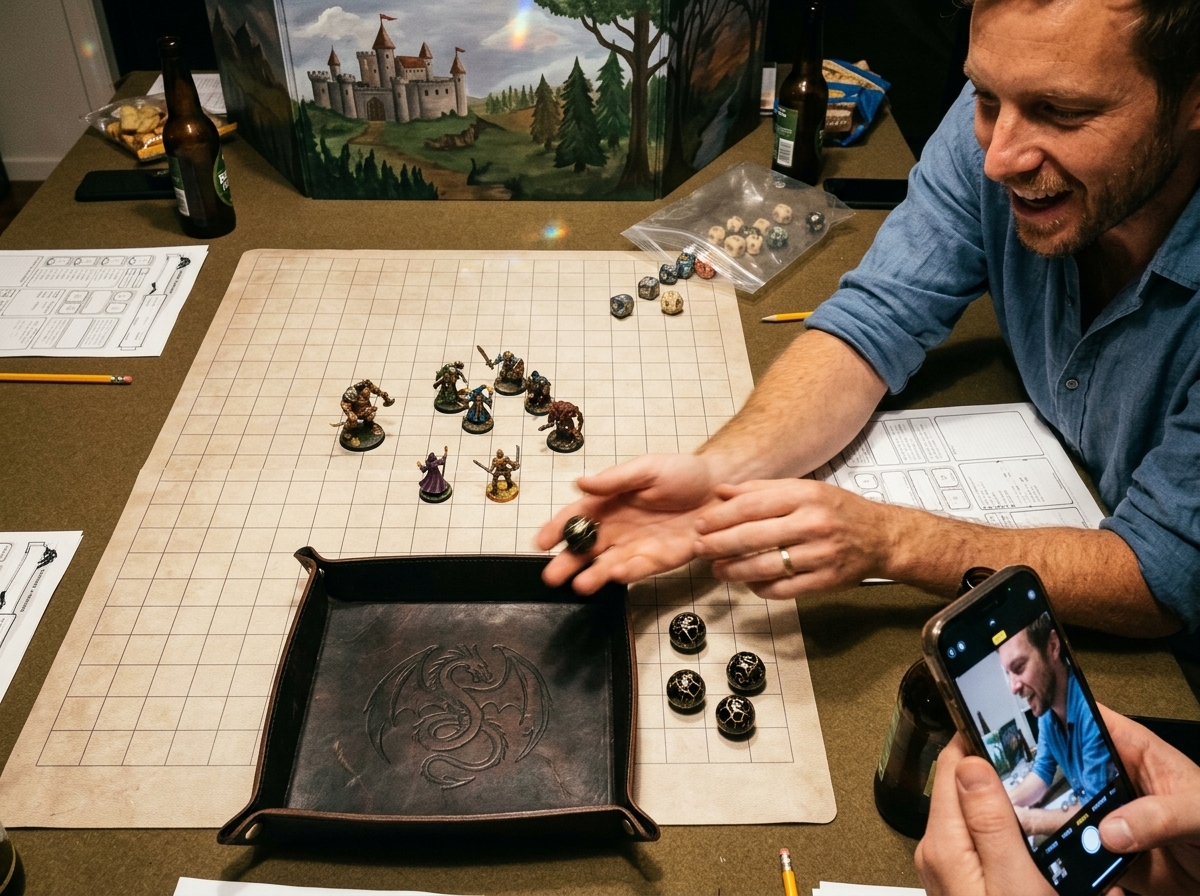
The weird thing is, I'd spent actual money on everything else.
I'd commissioned a woodworker to build my screen.
I'd bought a Creality just to print custom terrain.
I'd learned to paint minis from YouTube at two in the morning because I couldn't sleep and needed the party's rogue to look exactly right.
But the dice?
Same ones I bought at a hobby shop in 2018.
Chessex, I think.
Maybe $12.
One of the corners was chipped.
The gold ink on the d20 had rubbed off so much you had to hold it up to the light to read the 17.
I told myself it didn't matter.
Dice are dice, right?
They roll, they land, the math works.
Nobody cares what they look like.
Except I did.
Every time someone new joined the table, they'd compliment the setup — the screen, the tray, the minis.
And I'd feel this little pang of embarrassment when I reached for my dice.
Like showing up to a black-tie event in a tuxedo and sneakers.
I started noticing what other DMs were using.
Not just at my local shop, but online — the photos people posted in forums, the close-ups in actual play streams.
Metal sets.
Resin sets with flowers suspended inside.
Custom-engraved sets with dragons and runes.
And I realized: the people who took their tables seriously didn't settle for generic plastic.
They treated their dice like the signature piece.

So I started asking around.
I messaged a DM I respected from a Discord server and just asked him straight: what dice do you actually use?
He sent me a link.
Orbidice.
I'd never heard of them.
I clicked through, half-expecting another Etsy store with $90 resin cubes that looked cool but rolled like garbage.
But these weren't cubes.
They were spheres.
Actual spheres.
Like marbles, but with numbers inked by hand and a patented weighted core inside that made them stop on a dime.
I watched the video on the page — a d20 rolling across a table, smooth and fast, then snapping to a perfect stop on 14.
No wobble.
No rolling off the edge.
Just physics and craft.
The set I kept staring at was called Royal Nox Black.
Black spheres with gold veins running through them like cracked dragon eggs.
Gold hand-inked numerals.
They came in this matte black presentation case that looked like something you'd find in a museum vault.
It was €69.
I sat there for ten minutes just looking at the price.
That's more than I'd ever spent on dice.
That's more than most people spend on an entire hobby in a year.
But I thought about the campaign photos.
I thought about the chipped d20 I'd been rolling for six years.
I thought about what my table actually said about the kind of DM I wanted to be.
And I bought it.
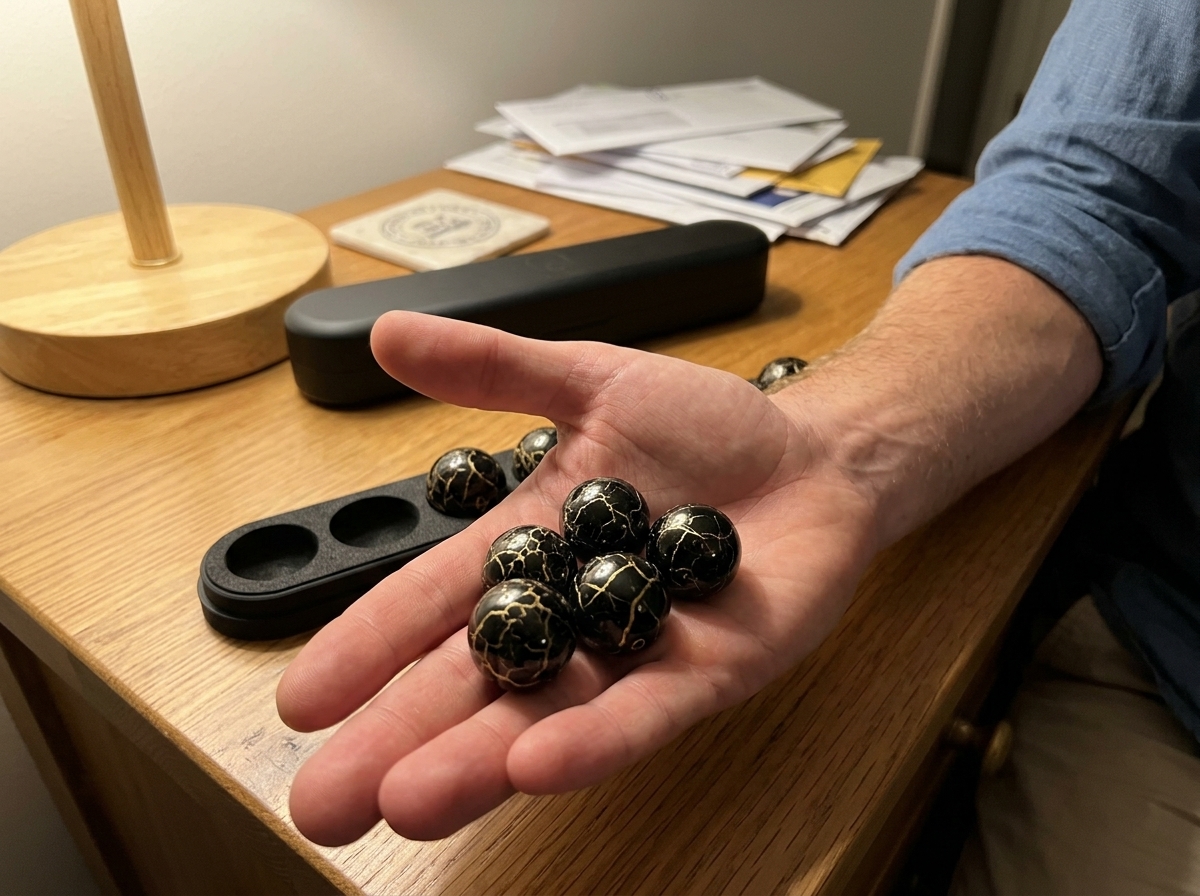
When the box arrived, I didn't open it right away.
I left it on my desk for two days.
I wanted to wait until Thursday.
I wanted the table to see them the way they were meant to be seen — in the middle of a session, under pressure, when a roll actually mattered.
So I waited.
And when Thursday came, I didn't say a word.
I just set the case on the table, opened it, and started the session.
First roll of the night, I picked up the d20.
It felt heavier than I expected — not just weight, but presence.
I rolled initiative for the ambush I'd been planning for three weeks.
The die hit the mat, rolled smooth like a marble, and stopped dead on 18.
The table went quiet.
Then my rogue leaned forward and said, "Wait, what the hell are those?"
I didn't even have to sell it.
The dice sold themselves.
By the end of the session, three people had asked where I got them, and I sent them the link right there at the table.
I've been using the Royal Nox Black set every Thursday for four months now.
They've never chipped.
They've never rolled off the table.
They've never failed to stop exactly where the math says they should.
And every time someone new sits down, they notice.
Not because I point them out.
Because they're impossible to miss.
If someone had told me a year ago that I'd spend €69 on a set of dice, I would've laughed.
But here's what I'd tell someone who doubts this:
First, the price isn't just for novelty — Orbidice ran an €826k Kickstarter with over 9,000 backers, and they've delivered more than 120,000 dice since then.
This isn't some Instagram gimmick.
It's a patented design that actually works.
Second, the fairness question: these roll more truly than any cube I've ever used.
The weighted core is engineered to stop the roll without bias.
I've logged every roll for two months.
The distribution is dead even.
Third, durability: I use these every single week, and they look exactly the same as the day they arrived.
The resin is scratch-resistant, the ink doesn't fade, and the case keeps them protected when they're not in play.
And fourth, if any of this sounds wrong after you buy them, there's a 60-day money-back guarantee.
You can return them, no questions asked.
I didn't need it.
But it's there.
The thing nobody tells you about building a table is that it's never really finished.
There's always one more thing you could upgrade, one more detail you could refine.
But the dice?
The dice are the thing people touch every ten minutes.
They're the thing that sits in the centre of every dramatic moment.
They're the last piece that makes the whole setup feel complete.
If any of this sounds like where you are — if you've built everything else and you're still rolling the same plastic you started with — this is where I'd start.
It's the one upgrade I wish I'd made years ago.
And the only one I'll never have to make again.
The exact set I use is right here.